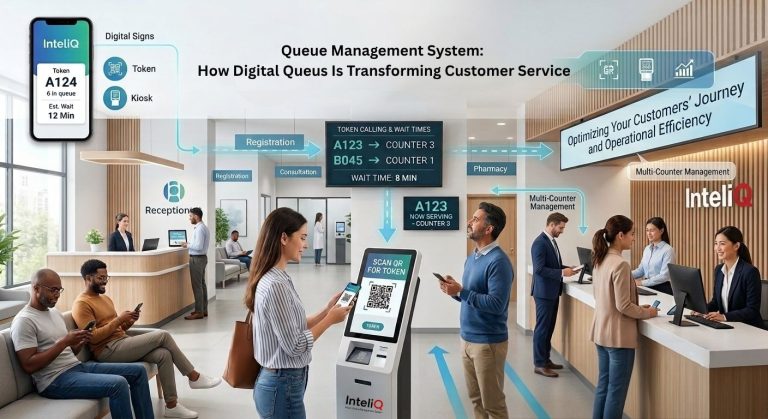
Waiting is a normal part of many customer journeys, but long and unorganized queues can quickly turn a simple service interaction into a frustrating experience. Banks, hospitals, government offices, retail stores, telecom centres, visa centres, and other service organizations often deal with high customer volumes, multiple service counters, different priorities, and unpredictable waiting times.
A queue management system provides a structured way to manage this customer flow. Instead of relying on physical lines and manual token handling, organizations can use digital tokens, self-service kiosks, QR codes, web applications, SMS or WhatsApp notifications, digital displays, and real-time dashboards to create a more organized service environment.
What Is a Queue Management System?
A queue management system is a technology-based solution designed to organize customers or visitors while they wait for a service. It manages the complete queue journey—from arrival and registration to token generation, waiting, service allocation, counter movement, and feedback.
Traditional queuing usually requires customers to stand in line or wait near a reception desk until someone becomes available. A digital queue management system separates the customer from the physical queue. A visitor can receive a token, understand their position, and in many implementations continue with other activities while waiting.
For organizations, the system provides visibility into customer flow. Management can monitor queue volume, waiting time, service time, counter performance, peak periods, and other operational information through centralized dashboards.
How Does a Queue Management System Work?
The exact workflow can vary depending on the industry and service model, but a typical digital queue begins when a customer arrives or checks in remotely.
A customer may generate a digital token through a self-service kiosk, QR code, website, mobile application, reception desk, appointment system, or other integrated channel. The customer can select the required service and, where applicable, choose a priority category or language.
The queue engine then places the customer into the appropriate service queue. When the customer approaches their turn, notifications can be delivered through SMS, WhatsApp, mobile interfaces, digital displays, or voice announcements.
At the service counter, staff can call the next token and begin the interaction. If the customer’s request requires another department or counter, the token can be transferred instead of requiring the customer to start the process again.
Once the service is completed, the system can record service information and invite the customer to provide feedback. This creates a connected journey from arrival to service to feedback and analysis.
Why Digital Queue Management Matters
A queue is more than a line of people. It represents a flow of customers moving through an organization’s operational processes.
When that flow is poorly managed, organizations may experience overcrowded waiting areas, unclear customer movement, uneven workloads between counters, unnecessary transfers, longer perceived waiting times, and limited information about what is happening inside the operation.
A queue management system brings these activities into a structured digital workflow. Customers receive clearer information about their journey, while employees and managers gain better visibility into the workload.
The objective is not simply to make a queue look more modern. The larger objective is to make the customer flow more predictable, measurable, and manageable.
Digital Tokens and Multiple Ways to Join a Queue
Modern queue management does not have to depend on a single token machine.
Customers can join a queue using different channels according to the organization’s requirements. A branch may provide a kiosk for walk-in visitors while also allowing customers to scan a QR code or join through a web application.
Appointment-based organizations can connect the queue with scheduled visits, while high-volume environments may support multiple entry points.
This flexibility is particularly useful when organizations serve different types of customers. Some visitors may prefer self-service, while others may require assistance from reception staff.
Virtual Queuing: Wait Without Standing in Line
One of the important developments in digital queue management is virtual queuing.
With a virtual queue, a customer can receive a digital position without remaining physically in front of a counter. Depending on the implementation, customers may be able to wait elsewhere within the premises or receive notifications before their turn.
For example, a hospital visitor could register for a consultation, receive a token, and monitor their status on a mobile device or display. A bank customer could complete the initial registration process and receive an alert when their service is approaching.
Virtual queuing can help organizations make better use of waiting areas while giving customers greater flexibility during the waiting period.
Priority Management for Different Customer Needs
Not every customer should necessarily follow the same queue rules.
Hospitals may need to accommodate different patient categories. Banks and government organizations may have defined priority policies. Other service environments may need special handling for senior citizens, people with disabilities, appointments, or specific service categories.
A queue management system can incorporate configurable priority rules so that the organization can manage these situations consistently.
The important point is that priority should be based on clearly defined business or service rules rather than ad-hoc manual decisions.
Digital Signage and Real-Time Customer Communication
Waiting becomes more manageable when customers know what is happening.
Digital displays can show currently served tokens, upcoming tokens, counters, service information, announcements, directions, or other relevant content.
Voice announcements can complement the display by informing customers when their token is called.
Digital signage can also turn waiting-area screens into a communication channel. Organizations may display educational content, service information, health awareness messages, promotional campaigns, financial information, or brand communications while customers wait.
This creates an opportunity to make the waiting environment more informative instead of leaving customers with no information about their status.
Queue Management in Hospitals
Healthcare facilities often have some of the most complex customer-flow requirements.
A patient’s journey may include several stages such as appointment, registration, token generation, consultation, laboratory services, pharmacy, billing, and feedback.
A queue management system can connect these stages into a structured workflow. Instead of treating every queue as an isolated activity, the organization can manage movement between departments and provide customers with information about the next step.
For hospitals and clinics, the system can also support multiple service categories, priority handling, digital tokens, waiting-area displays, notifications, service-time tracking, and management analytics.
The result is a more coordinated approach to managing patient and visitor movement throughout the facility.
Queue Management for Banks and Financial Services
Bank branches frequently handle several types of services at the same location, including account services, deposits, withdrawals, loans, customer support, documentation, and other requests.
A queue management system can categorize customers according to their selected service and route them toward the appropriate counter or employee.
Branch managers can use operational information to understand customer volumes and service activity. Historical data can also help organizations identify busy periods and review staffing requirements.
When integrated with other banking or customer-service systems, queue information can become part of a broader branch-management workflow.
Queue Management for Government Offices
Government service centres often handle high visitor volumes and multiple departments.
Digital queue management can help organize citizens according to service type, appointment status, and defined priority rules. Customers can receive tokens and notifications while staff can monitor queue activity from a centralized interface.
For government environments, clear communication is particularly important because visitors may not be familiar with internal departmental processes. Digital displays and structured token workflows can make the service journey easier to understand.
Queue Management for Retail and Customer Service Centres
Retail stores, service centres, telecom outlets, automobile service facilities, educational institutions, and other customer-facing organizations can also use digital queuing.
The system can separate customers by service requirement, helping staff understand what type of assistance is waiting.
For example, a telecom centre may have separate queues for new connections, billing, technical support, and account-related requests. Instead of maintaining one physical line, the system can organize customers according to the service they require.
Measuring Waiting Time and Service Time
One of the major advantages of a digital queue management system is that operational activity can be measured.
The system can capture information such as:
These measurements help management understand where delays are occurring.
For example, if one service consistently has longer waiting times than others, the organization can investigate whether the issue is related to staffing, process complexity, demand patterns, or another operational factor.
Queue Analytics and Better Decision-Making
A queue management system becomes more valuable when its data can be converted into useful operational insights.
Dashboards can provide real-time visibility into the current queue while historical reports can help identify trends over days, weeks, or months.
Managers can use this information to examine customer demand, counter utilization, service duration, peak hours, and bottlenecks.
Instead of asking, “Why is the queue long today?” management can begin working with measurable information about when, where, and why customer flow is slowing down.
This makes queue management part of broader operational improvement rather than simply a token-generation solution.
Integrating Queue Management With Other Business Systems
A modern queue management system does not always operate independently.
Organizations may integrate queuing with:
Integration can reduce duplicate data entry and create a more connected customer journey.
For example, when a queue system is integrated with a hospital or banking application, information captured during the customer’s journey can potentially be connected with the organization’s existing workflow.
Connecting Queue Management With Customer Feedback
The queue experience does not end when a customer reaches the counter.
The quality of the actual service is equally important.
A feedback system can be connected to the queue workflow so customers can provide feedback after completing their service. Feedback can be collected through QR codes, kiosks, SMS, WhatsApp, web interfaces, or other channels.
Organizations can then analyze feedback alongside operational information.
For example, management may discover that a particular service has reasonable waiting times but receives poor feedback because of another part of the customer journey.
This is why combining queue management, customer communication, feedback, and analytics can provide a broader view of customer experience.
Turning Waiting Time Into a Communication Opportunity
Waiting time is often viewed only as a problem. However, the waiting period can also become an opportunity for communication.
With digital signage integrated into a queue environment, organizations can display relevant content while customers wait.
A hospital could display health information and patient guidance. A bank could communicate financial products or service information. A retail environment could promote products or offers.
The content should remain relevant and should not interfere with important queue information such as token numbers and service notifications.
What Should You Look for in a Queue Management System?
Organizations considering a queue management system should evaluate the solution based on their actual operational requirements.
Important considerations include:
Multiple queue-entry options: Can customers join through kiosks, QR codes, websites, mobile applications, appointments, or assisted registration?
Priority management: Can the organization configure different priority rules?
Service and counter management: Can customers be routed to the correct service point?
Notifications: Does the system support appropriate customer notification channels?
Digital displays: Can token information and customer communication be displayed clearly?
Analytics: Can managers monitor waiting time, service time, queue volume, and operational performance?
Integration: Can the solution connect with existing business applications?
Scalability: Can it support multiple counters, departments, branches, or locations?
Customization: Can workflows be adapted to the organization’s industry and operating model?
Security and access control: Can sensitive operational information be protected and accessed only by authorized users?
A solution should be evaluated not only on its interface but also on how well it fits the organization’s actual customer journey.
InteliQ: A Connected Approach to Queue Management
TecnoviQ’s InteliQ Queue Management System is designed around the idea that queue management should be more than digital token generation.
InteliQ can support digital token creation through QR codes, kiosks, web applications, and other channels, along with service selection, priority handling, customer notifications, digital displays, voice announcements, counter management, token transfers, feedback collection, and analytics.
The platform can also be connected with digital signage, self-service kiosks, customer feedback workflows, and existing business systems according to organizational requirements.
For industries such as healthcare, banking, retail, government, telecom, and customer service centres, the objective is to create a connected flow from customer arrival to service completion and feedback.
The Future of Queue Management
Queue management is increasingly becoming part of a larger digital customer-experience strategy.
Organizations are moving from simple physical token systems toward connected platforms that combine virtual queuing, digital communication, analytics, self-service, workflow automation, feedback, and system integration.
The future of queue management is therefore not simply about reducing the number of people standing in a line. It is about understanding customer movement, improving operational visibility, communicating clearly with customers, and continuously improving the service process using real-time and historical data.
For any organization managing significant customer traffic, the right queue management system can become an important component of a broader digital transformation strategy—connecting people, processes, technology, and customer experience in one structured workflow.